- The Wealth Expedition
- Posts
- Most Investors Miss the Moment When Fear Turns Into Opportunity
Most Investors Miss the Moment When Fear Turns Into Opportunity
Watch for this threshold. When it gets crossed, history shows it often marks a major shift.

Daniel Lancaster
December 06, 2025


Good morning pioneers!
As the holidays approach and 2025 draws to a close, it’s the perfect time to reflect:
Did we reach our goals this year?
What changed along the way?
And what new milestones will we set for 2026?
If I may suggest one New Year’s goal: make this the year you truly turn your financial life around.
I hope you’ll consider joining the Founding Member Waitlist for the membership, which is just days away from launching. I’m daily in discussions with my team about the go-live process, fine-tuning every detail, and very soon, the doors will open.
This membership is about more than just financial knowledge—it’s a place to transform your mindset, expand your skills, and take actionable steps toward a life of abundance.
We’re on this journey together, not only for ourselves but to create a ripple effect that benefits society as a whole. It takes a courageous few to catch the vision, apply the knowledge, and blaze the path toward a brighter horizon.
We’re right on the brink. Let’s take this step together.
In the meantime, I want to share a little-known market insight with you today—something that could shift the way you think about fear, opportunity, and timing in the market.
Onward together,
Daniel

📽️ I’ve also covered this topic in a short YouTube video—check it out here.
Most Investors Miss the Moment When Fear Turns Into Opportunity
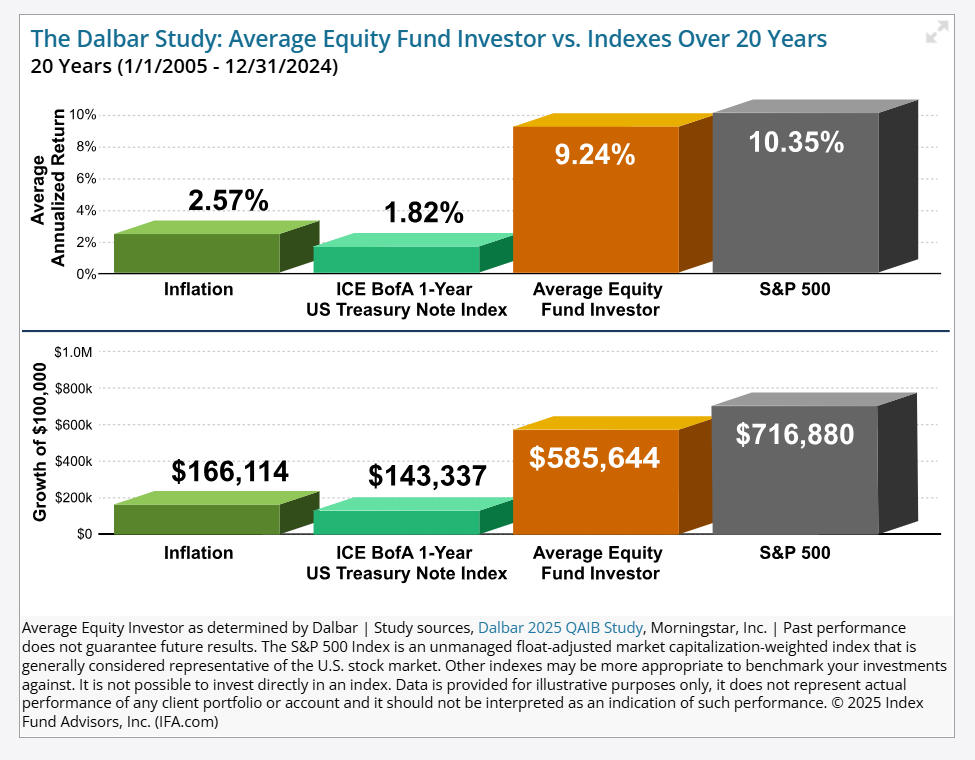
Many people still cling to the idea that there are individuals out there who can consistently jump in and out of the market and beat everyone else — day traders, swing traders, or lone-wolf market wizards who supposedly sidestep most declines and catch most upsides.
It’s an appealing story, because we dream of one day being among their ranks.
But in reality, this level of consistency in short-term trading is largely fiction for individual investors, and even for nearly all professionals who aren’t operating as market-makers on a trading floor (who have an advantage).
A good analogy is a coin flip.
It’s entirely possible to flip a coin and land on heads ten times in a row. You might even know someone who claims to have done something like that in the markets — a hot streak that lasted for months or even a couple of years. But stretch that same logic out to 1,000 coin flips, and the likelihood of hitting heads 70% of the time becomes virtually zero.
Sooner or later, the odds catch up.
That’s exactly what happens with habitual market timing. You can get lucky for a while. Eventually the probabilities gain the upper hand. That’s often where individuals sacrifice enormous long-term returns, especially when they change strategies every few years in an attempt to optimize their timing.
So why is it so tempting to try?
Because markets fall.
They fall often.
And the falls feel predictable in hindsight (called Hindsight Bias).

Volatility is Normal — and Most Predictability Is an Illusion
The market regularly experiences an average of:
Pullbacks of 5–10% about 3–4 times per year
Corrections of 10–20% roughly every 18 months
Bear markets of 20%+ about once every 4–5 years, with wide variation
The mistake investors make is assuming these declines must be avoided to succeed. “If I can sidestep the pain,” the thinking goes, “I’ll grow faster.”
But the declines themselves aren’t the problem. Our responses to them are.
Pullbacks and corrections are often driven less by real economic deterioration and more by psychological contagion — fear, headline panic, and sudden narrative shifts. And the irony is that because these are sentiment-driven, they frequently rebound just as quickly as they drop.
In fact, most short-term declines recover so fast that the risk of sitting through them is far smaller than the risk of missing the rebound by pulling money out “just in case.” Missing just a handful of the market’s best days, days that regularly occur in the middle of a panic, can devastate long-term returns.
To illustrate this, let’s look at an actual quantitative study of how markets behave during periods of widespread fear.
When Panic Hits, Opportunity Follows: Insights from %52-Week Lows
Pongpat Khamchoo, CMT, CAIA — Head of Technical Analysis at Yuanta Securities in Bangkok — recently conducted a decade-long backtest (2014–2024) on five major indices: the S&P 500, NASDAQ, Russell 2000, Vietnam Index, and Thailand’s SET Index.
His research focused on a powerful but under-appreciated breadth indicator:
%52-Week Lows
The percentage of stocks within an index that are hitting new 52-week lows.
When this number crosses 30%, it often has historically indicated a “panic sell” phase — a moment when fear becomes indiscriminate and roughly one in three stocks has broken down.
In other words: full-blown capitulation.
And here’s what the backtest found.
When panic peaks, rebounds are common.
Across all five indices:
20-day holding period: 77% win rate, +4.67% average return
60-day holding period: 89% win rate, +13.85% average return
100-day holding period: 70% win rate, +11.98% average return
The optimal hold time after a panic signal?
About 60 trading days — roughly three months.
U.S. indices tended to recover the strongest. Emerging markets experienced panics more frequently but bounced more weakly. This is largely a reflection of liquidity differences, investor behavior, and macro structure.
The broader takeaway is simple:
When panic becomes widespread, opportunity becomes abundant.
Fear leaves fingerprints in the data, and the %52-Week Lows indicator helps you recognize those rare but powerful moments when sellers have exhausted themselves.
How to Track Panic Conditions Yourself
You don’t have to guess when the market is approaching these extremes.
A simple method is:
Visit Yahoo Finance’s Top Recent 52-Week Lows screener.
Check how many stocks appear.
Cross-reference with the index you follow.
If the S&P 500 has ~500 constituents and ~150 are hitting new lows, that’s 30%.
When an index reaches that threshold, the historical odds tilt heavily toward short- to medium-term recovery.
The point isn't to blindly buy every dip, but to recognize that chronic fear is often followed by outsized gains.
And this brings us to the big objection that’s probably on your mind:
“Yeah… but what about 2008 or 2022? Those weren’t quick rebounds.”
Exactly! And that’s why disciplined frameworks matter.
Managing Risk Without Trying to Predict the Future
Mass panics (like 2008, 2020, and 2022) are real. No indicator can prevent all losses or perfectly time market cycles.
But here’s the distinction that matters:
The goal is not to be perfect.
The goal is to consistently play the odds that work over long horizons.
That’s one reason I built The Wealth Expedition membership.
Inside, I help investors:
1. Assess market risk using a full Economic Dashboard.
You get ongoing insights about the environment we’re actually in — not just headlines, not emotional guesses.
2. Build portfolios tailored to different risk levels.
The Featured Investment Strategies are designed for various investor types, helping you think more strategically rather than reactively.
3. Track investable opportunities intelligently.
The Investment Watch List highlights funds and ETFs that align with the principles taught in the course, so you can conduct deeper analysis without starting from scratch.
It’s not about calling tops and bottoms.
It’s not about avoiding every decline.
It’s about making smart, repeatable decisions that stack the odds in your favor over time.
And we are just days away from launching.
If you’re not yet on the Founding Members Waitlist, now is one of your last chances before the doors open.
I hope to see you inside!
How did you like today's newsletter?I'm always looking for ways to offer greater value to fellow explorers. Your feedback helps set the direction for future content! |

I’d love to hear from you. Let me know what you’d like to see in upcoming newsletters, articles, or a digital course at Contact Us - The Wealth Expedition.