- The Wealth Expedition
- Posts
- Quit, Persist, or Pivot? A Framework for Entrepreneurs
Quit, Persist, or Pivot? A Framework for Entrepreneurs
Avoid wasting energy on the wrong path. Learn the three-question test from The Dip to know when to pivot in business.

Daniel Lancaster
February 28, 2026


Good morning, pioneers,
Today we’re diving into insights from Seth Godin’s book The Dip. If you’ve ever wondered how to make big-picture decisions about where to persist, when to pivot, or even when to quit, this will give you a practical framework to think about direction in your career or business.
The principles go beyond entrepreneurship—they apply to health goals, education, personal growth, and even relationships. My hope is this perspective brings clarity to a topic that’s rarely discussed.
Have a great weekend!
Onward together,
Daniel

📽️ I’ve also covered this topic in a short YouTube video—check it out here.
Knowing When to Persist, Pivot or Quit
There’s a paradox most entrepreneurs wrestle with:
Success requires both persistence and the ability to quit wisely.
We’ve all been told, “Never give up.” Persistence matters. As Napoleon Hill said in Think and Grow Rich,
“There is no substitute for persistence…Failure cannot cope with persistence.”
But here’s the catch:
Persistence toward the wrong thing is not perseverance — it’s prolonged failure.
Imagine someone devoted to inventing a perpetual motion machine powered only by gravity. No amount of grit will make that possible — because the direction itself is impossible. Persistence without right direction is wasted energy.
So the real question isn’t just “How do I persist?”
It’s when should I pivot?
This is where The Dip, a concept popularized by Seth Godin, helps entrepreneurs think more clearly about direction. It’s not simply about quitting or sticking. It’s about evaluating whether you’re on a path worth enduring or one that needs changing.

The Three Curves Every Endeavor Faces
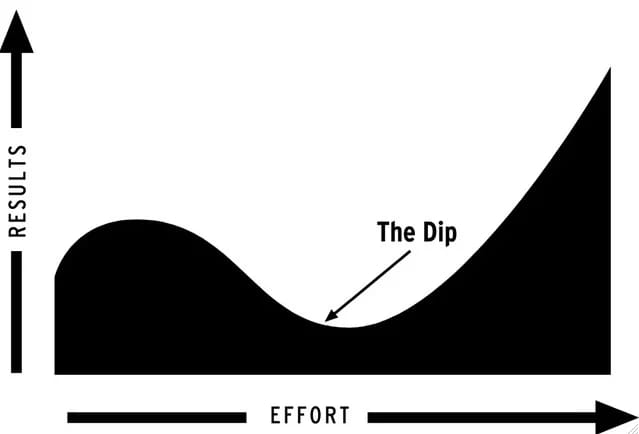
According to The Dip, most efforts fall into one of three patterns:
The Dip: A temporary period of slow progress that, if you persist, leads to mastery, scarcity, and advantage.
The Cul-de-Sac: A dead end where you work hard indefinitely and nothing meaningful changes.
The Cliff: A path that ultimately leads to sudden failure or harm.
These can feel similar in the moment: frustration, slow growth, resistance, little feedback. But the correct decision depends on which curve you’re truly on.
A Simple Test for Strategic Pivoting
Instead of guessing, Seth Godin encourages asking yourself three diagnostic questions before committing to continue or to pivot:
1. Am I Panicking?
Emotion is a terrible compass. Most people think about quitting from fear — exhaustion, rejection, or comparison. But emotional panic is short-term noise. If you’re considering giving up because you feel defeated, that’s not a rational signal. It may just be a normal part of The Dip.
Instead, pause and evaluate:
Am I making decisions from stress or strategy?
Am I reacting or analyzing?
If quitting feels like relief in the abstract, but logical evaluation still supports potential growth, you may be in the Dip — not in a dead end.
2. Can I Be Remarkably Good at This?
“Best in the world” doesn’t mean global dominance. It means being extraordinary for a hyper specific audience or niche. You shrink the world you're competing in so that you can dominate it. You don't start out playing in the big leagues. You start out in the little league (which is all you really need to meet with great success), and if you desire later, you can work your way up using momentum.
Most people fail because they chase broad ambition without precision. But Seth Godin’s insight is that the reward isn’t just about sticking through discomfort — it’s about becoming truly exceptional in a focused arena.
Ask yourself:
Is this niche focused enough that I can realistically become the leader?
Does this path let me leverage unique strengths?
Is there a clearly defined target I can serve better than anyone else?
If your chosen market or model doesn’t allow for that level of distinction, persistence won’t lead to greatness — it will just lead to average results. Average isn’t bad. You can make a decent living on average results.
It's all about knowing your aim and accepting the likely outcome.
3. Is There Measurable Progress?
Progress isn’t always steep, but it needs to be present.
Progress markers might be:
Increased revenue
Growing audience engagement
Better retention or conversions
Accumulation of skills or network expansion
Even slow improvement is usually a sign of being in the Dip — a struggle you can overcome. But if there’s zero growth despite persistent effort, that’s a red flag you may be in a Cul-de-Sac or worse.
If effort doesn't yield measurable improvement over time, it may be time to pivot.
Pivoting Is Not Failure — It’s Strategic Resource Allocation
Too often, entrepreneurs feel that quitting equals defeat. But quitting the wrong things frees up time, energy, and capital for pursuits where you can actually excel. This is a form of risk management — not the financial safety nets we usually think about, but directional risk management.
The goal isn’t simply endurance. It’s focused endurance toward meaningful results.
Strategic quitting of certain strategies or tactics you’ve tested lets you reallocate:
Your time toward better opportunities
Your money toward promising initiatives
Your attention toward work that actually moves the needle
If you stay locked into a project that shows no progress over a reasonable timeframe, you’re effectively burying your best resources in something that won’t deliver returns.
The Bigger Picture: Growth Beyond Business
The three-question framework applies far beyond entrepreneurship. You can use it to evaluate:
Health goals — Is your current strategy improving results or just keeping you busy?
Career paths — Are you developing rare skills, or stuck in a plateau?
Education choices — Is your degree or program moving you closer to your goals?
Relationships — Is conflict temporary growth pain or a structural mismatch?
In everything worth pursuing, there will be resistance. The trick is learning to distinguish productive discomfort from directionless struggle.
When to Pivot — Signs It’s Time
Here are some practical signals it may be time to consider a pivot or course correction:
Plateauing despite focused and sustained effort
Worsening margins or unsustainable costs
Customer acquisition stagnation
Lack of clarity on how to lead your niche
Chronic stress without measurable progress
Low joy or passion despite effort
None of these requires panic. They require honesty.
If you’re hesitant but the metrics aren’t improving, ask yourself:
Am I pushing through discomfort — or just pushing against a wall?
Don’t Confuse Persistence With Obsession
Persistence is a habit. But persistence without direction becomes compulsion. Being relentless isn’t always admirable — unless it moves you closer to meaningful results.
Strategic pivoting is not a lack of grit.
It’s smart allocation of a precious resource — your time.
Every project you quit makes space for something you can succeed at. Success — true success — rarely comes without hardship. But it comes from hardship in the right direction.
Your Next Step on the Wealth Expedition — When You’re Ready
For deeper insights into how budgeting, investing and ownership work together as a system for building wealth, here are two ways to continue:
1. Join The Wealth Expedition Membership
Inside The Citadel membership, you’ll gain access to the world of Entrepreneur Expanse, along with Budgeting Bayou and Investing Islands. Each world gives you frameworks, tools, and actionable guidance to map your current position, chart your next steps, and move forward intentionally.
2. Get personalized financial planning
If you want help evaluating your current plan, identifying next steps, and building actionable strategies for wealth while balancing risk and lifestyle, I offer personalized planning.
Write me to schedule a free discovery call and get clarity before making your next major financial move.
How did you like today's newsletter?I'm always looking for ways to offer greater value to fellow explorers. Your feedback helps set the direction for future content! |

I’d love to hear from you. Let me know what you’d like to see in upcoming newsletters, articles, or a digital course at Contact Us - The Wealth Expedition.